Great Pacific War: A History of the American-Japanese Campaign of 1931-33 by Hector C. Bywater
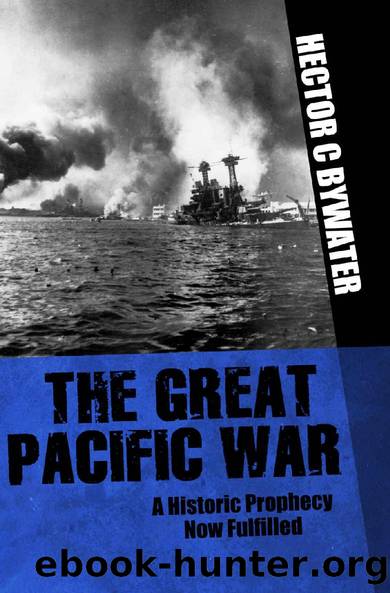
Author:Hector C. Bywater [Bywater, Hector C.]
Language: eng
Format: epub
Publisher: Albion Press
Published: 2016-05-18T22:00:00+00:00
CHAPTER XII
Expedition suffers severe damage in a gale â Arrangements for junction of squadrons dislocated â Japanese take the alarm â Expedition retreats, but is brought to action by Japanese â Both sides suffer heavily â Return of remnant of expedition
AFTER a twenty-four hoursâ stay at Midway, where the final arrangements were concerted, the expedition left on December 27 for the second stage of its voyage â the 1034-mile run to Wake Island. The battle fleet sailed a day later, steering a course more to the northward. The weather, up to this date, had been propitious, but on the night of December 29 a violent south-west gale broke. Huge waves swept over the transports, causing much damage to boats and deck gear, while the look-out men, blinded by flying spray, could no longer see the dim stern lights that marked the position of the ships, this being the only illumination permitted now that the expedition was nearing enemy waters. At 1 a.m. on the 30th, when the storm was at its height, the transport Marquette was rammed by her next astern, the Arlington, which struck her a violent blow on the port quarter, tearing a great rent in her side and putting the steering gear out of action. Instantly the damaged ship began to fill, her plight being rendered hopeless by the mountainous seas which broke over her as she lost way and became unmanageable. Searchlight signals apprised the rest of the scattered convoy of the disaster, but it was little they could do to help their ill-starred consort. As the 1,200 troops on board the Marquette tried to muster on deck, scores were swept to their doom by the waves that washed over the waterlogged vessel. No boats could live in such a sea, and of the few that were lowered, none survived for more than a minute. By now, however, destroyers were on the scene. With splendid gallantry the commanders of the Somers, Worden, and Bancroft brought their craft alongside the sinking ship, disregarding the imminent peril of being dashed against her hull. Seeing help near at hand, most of the soldiers threw themselves into the water, and though many were engulfed, 530 were picked up by the destroyers. Half-an-hour after the collision the Marquette gave a last lurch and foundered by the stern. Including members of the crew, upwards of 900 lives were lost.
Nor did this complete the full tale of the disaster, for at 1.30 a.m. the Arlington reported herself to be making water fast and unable to steer. Her bows had been stove in when she ran into the Marquette, and a large section of plating below the waterline wrenched away by a great sea that struck her as she was drawing clear of the former ship. With the forward bulkhead showing signs of collapse she dared not steam ahead; one of the forward compartments was flooded, the forecastle was nearly awash, and the propellers were lifting out of the water. Had the sea been
Download
This site does not store any files on its server. We only index and link to content provided by other sites. Please contact the content providers to delete copyright contents if any and email us, we'll remove relevant links or contents immediately.
Personalized inhaled bacteriophage therapy for treatment of multidrug-resistant Pseudomonas aeruginosa in cystic fibrosis by unknow(213434)
CONSORT 2025 statement: updated guideline for reporting randomized trials by unknow(102512)
Critical evaluation of the ProfiLER-02 study design and outcomes by Vivek Subbiah & Razelle Kurzrock(102039)
Cardiac gene therapy makes a comeback by Oliver J. Müller & Susanne Hille & Anca Kliesow Remes(101833)
Whisky: Malt Whiskies of Scotland (Collins Little Books) by dominic roskrow(74615)
Unveiling the design rules for tunable emission in graphene quantum dots: A high-throughput TDDFT and machine learning perspective by Şener Özönder & Mustafa Coşkun Özdemir & Caner Ünlü(50996)
A yeast-based oral therapeutic delivers immune checkpoint inhibitors to reduce intestinal tumor burden by unknow(40370)
Covalent hitchhikers guide proteins to the nucleus by Alexander F. Russell & Madeline F. Currie & Champak Chatterjee(40294)
Meet the Authors: Christopher R. Mansfield and Emily R. Derbyshire by Christopher R. Mansfield & Emily R. Derbyshire(40204)
Alkaline-earth metals promote propane dehydrogenation with carbon dioxide through geometric effects: Altering the reaction pathway by unknow(32812)
Induced iron vacancies boosting FeOOH loaded on sustainable Fenton-like collagen fiber membrane for efficient removal of emerging contaminants by unknow(32607)
Efficient electric-field-assisted photochemical conversion of methane to n-propanol exclusively over penetrated TiO2Ti hollow fibers by Guanghui Feng(32527)
Bi2SiO5 nanosheets as piezo-photocatalyst for efficient degradation of 2,4-Dichlorophenol by Hangyu Shi & Yifu Li & Lishan Zhang & Guoguan Liu & Qian Zhang & Xuan Ru & Shan Zhong(32464)
A novel NDIPTA organic heterojunction photocatalyst with built-in electric field for efficient hydrogen production by Jiahui Yang & Baojun Ma & Yongfa Zhu(32437)
Enhanced conversion of methane to liquid-phase oxygenates via hollow ferrite nanotube@horseradish peroxidase based photoenzymatic catalysis by Jun Duan & Shiying Fan & Xinyong Li & Shaomin Liu(32403)
Ordered macroporous superstructure of defective carbon adorned with tiny cobalt sulfide for selective electrocatalytic hydrogenation of cinnamaldehyde by Xiao-Shi Yuan & Sheng-Hua Zhou & San-Mei Wang & Wenbo Wei & Xiaofang Li & Xin-Tao Wu & Qi-Long Zhu(32330)
What's Done in Darkness by Kayla Perrin(27245)
Topological analysis of non-conjugated ethylene oxide cored dendrimers decorated with tetraphenylethylene: Insights from degree-based descriptors using the polynomial approach by A Theertha Nair & D Antony Xavier & Annmaria Baby & S Akhila(26627)
Investigation of mechanical and self-healing properties of hydroxyl-terminated polybutadiene functionalized with 2-ureido-4-pyrimidinone by Mohsen Kazazi & Mehran Hayaty & Ali Mousaviazar(26553)
